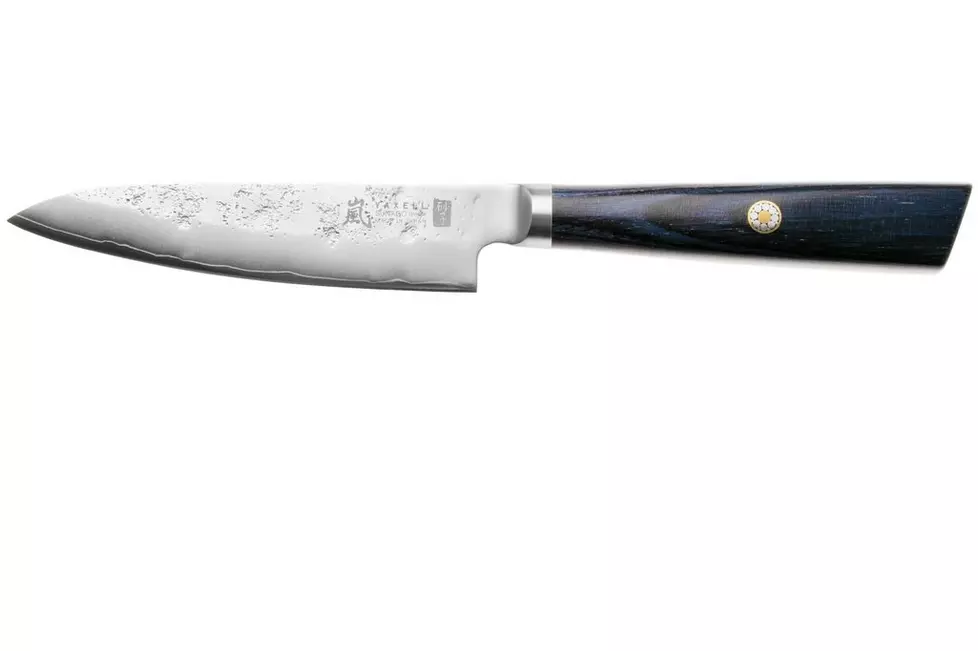
The Yaxell Sunago 12 cm utility knife is a compact Japanese petty designed for precise tasks such as trimming and cutting fruit and vegetables, portioning small pieces of meat, and all situations where a large chef’s knife is less practical. Its short blade offers excellent control and agility. Thanks to the Ginsan steel, you get a fine, sharp Japanese edge without the extra maintenance of carbon steel or the brittleness of ultra‑hard steels.
The three‑layer blade features a Ginsan (Gingami) steel core. This fine‑grained Japanese stainless steel is known for its sharpness and easy maintenance. With a hardness of around 59 HRC, it holds its edge well while being less brittle than many harder Japanese steels. The nashiji finish gives the blade a slightly textured surface reminiscent of Japanese pear skin.
The dark blue Takehisa handle is made from Pakkawood — thin layers of wood pressed together with resin. This makes it stable, moisture‑resistant, and low‑maintenance, while retaining the natural look of wood. A mosaic pin with a Japanese family crest adds a distinctive traditional detail.
✅ General Care
The knife should be washed by hand using warm water, then dried with a soft cloth to preserve its sharpness and material quality.
For long-term precision, use water sharpening stones; ceramic honing rods are ideal for fine edge adjustment during use.
Always store the knife properly to prevent contact with other kitchen tools and avoid potential damage.
It is recommended to use wooden, plastic, or rubber cutting boards, as they are gentler on the blade and extend its lifespan.
⚠️ Special Note on Traditional Japanese Steels
Japanese knives with high-carbon steel blades require special care to prevent oxidation and rust.
After each use, wash thoroughly with warm water and immediately dry with a dry cloth.
Occasionally applying a thin layer of mineral or camellia oil to the blade provides added corrosion protection.
Store knives in a dry place, avoiding prolonged exposure to moisture or aggressive cleaning agents.
? What to Avoid
Do not use the knife on hard surfaces such as glass, ceramic, steel, metal countertops, or baking trays.
Avoid cutting bones or frozen foods, as this may damage the edge.
Do not wash the knife in a dishwasher – chemicals and high temperatures can compromise both blade and handle integrity.
A Japanese knife is a precision instrument designed for specific culinary tasks. Do not use it for inappropriate purposes such as cutting bones, opening cans, or processing hard materials.
Send request

.webp)